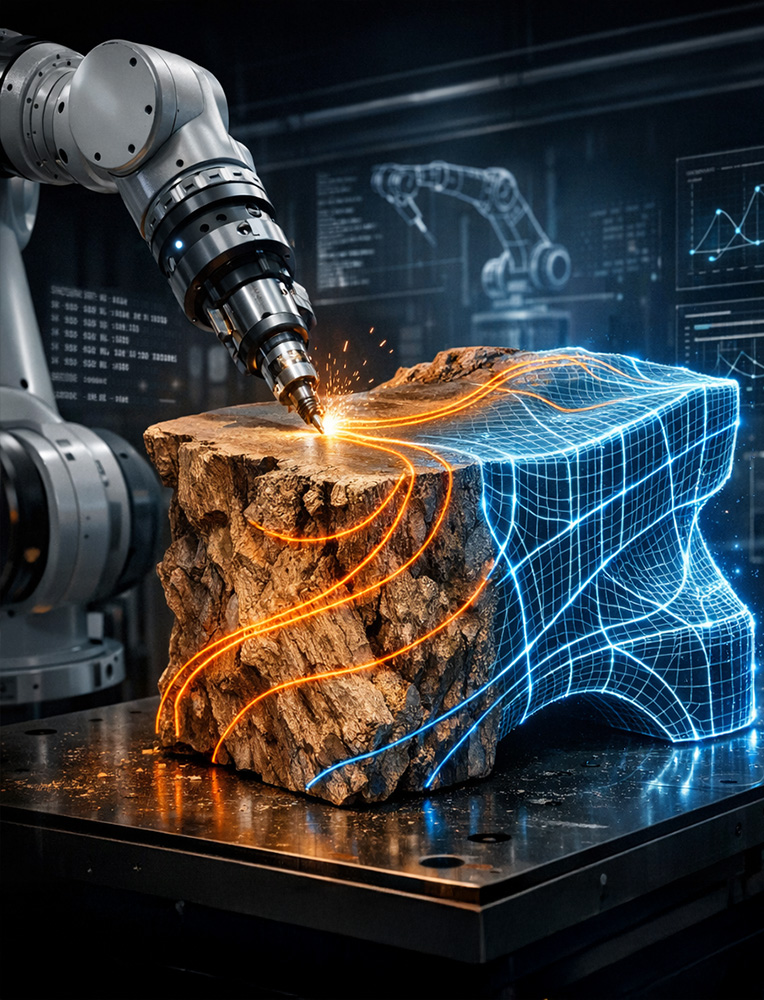
Teaching Robotic Fabrication for Irregular Geometry
This weekend, I’m leading a technical workshop at PA Academy titled Robotic Fabrication for Irregular Geometry.
The core problem we’re solving is that industrial robots expect mathematically perfect CAD models, but the real world is chaotic. When you work with found objects, existing structures, or organic materials, standard planar XYZ toolpaths (like those used in typical 3D printing) fail completely.
Instead of fighting the geometry, this workshop teaches a complete scan-to-robot pipeline to adapt to it:
- Digitization: Bypassing heavy photogrammetry by extracting 3D meshes from simple images using automated computer vision pipelines in Python/Colab.
- Rationalization: Cleaning and reconstructing the raw, messy mesh data inside Rhino 8 and Grasshopper.
- Surface-Aware Toolpaths: Writing parametric logic to generate robotic paths that actually “hug” the unpredictable geometry, keeping the robotic tool perpendicular to local surface normals.
- Validation: Running full kinematic simulations of a 6-axis arm using the Robots plugin to catch singularities and collisions before any physical movement.
It’s about moving past rigid modeled environments into responsive, adaptive fabrication.
Check out the full syllabus and workshop details at PA Academy ↗